Let’s talk about something that stresses out almost every self-employed person:
“What if I didn’t pay enough taxes this year?”
If you’re a 1099 worker, freelancer, creator, or small business owner, you don’t have taxes automatically withheld from your paycheck. That means you are responsible for sending the IRS estimated payments throughout the year.
And if you don’t send enough?
The IRS can charge you an underpayment penalty.
But here’s the good news:
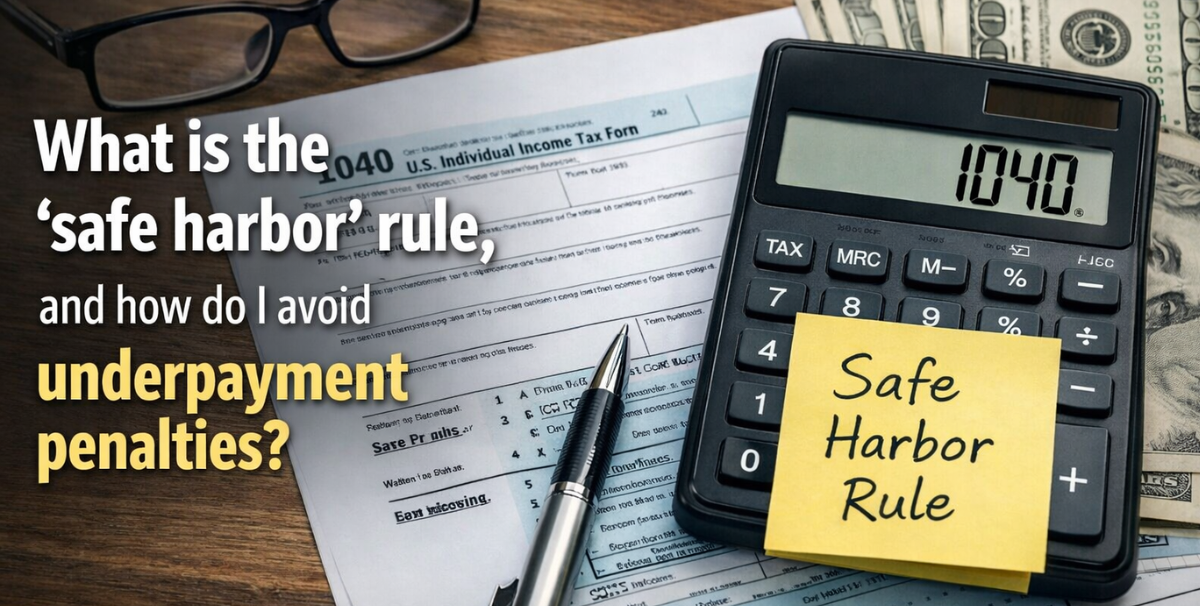
There’s something called the IRS safe harbor rule, and it can protect you.
Let’s break it down in plain English.
What Is the IRS Safe Harbor Rule?
The IRS safe harbor rule is basically a penalty protection rule. It says:
If you pay enough during the year, even if it’s not exactly what you owe, the IRS will not charge you an underpayment penalty.
It’s their way of saying: “We won’t punish you if you paid a reasonable amount based on past income.”
Notice something important here:
The safe harbor rule doesn’t eliminate taxes owed. It eliminates penalties.
Big difference.
How Much Do You Have to Pay to Qualify?
There are two main ways to qualify for safe harbor protection:
Option 1: Pay 100% of Last Year’s Tax Bill
If your adjusted gross income (AGI) was:
- Under $150,000 → Pay at least 100% of last year’s total tax
- Over $150,000 → Pay at least 110% of last year’s total tax
If you do that through withholding and/or quarterly estimated payments, you’re protected.
Even if you end up owing more in April.
Option 2: Pay 90% of This Year’s Tax Bill
If you accurately calculate and pay at least 90% of what you’ll owe this year, you also qualify. This works well if your income is steady and predictable.
But let’s be honest…
For most freelancers and 1099 workers, income is not steady or predictable. That’s why many people use last year’s tax bill as their benchmark.
What Happens If You Don’t Meet Safe Harbor?
If you don’t meet one of those thresholds, the IRS may charge:
- Underpayment penalties
- Interest on the unpaid amount
And here’s the part most people don’t realize: The IRS calculates penalties quarter by quarter.
So even if you “catch up” at the end of the year, you could still owe penalties for earlier quarters. This is why strategy matters.
Real-Life Example
Let’s say:
- Last year your total tax was $20,000
- This year your income jumps significantly
If you pay at least $20,000 during the year (assuming AGI under $150k), you’re protected under safe harbor. Now imagine you actually owe $28,000 when you file.
You’ll still owe $8,000 in April. But you won’t owe an underpayment penalty. That’s safe harbor doing its job.
Why This Matters for 1099 Workers
W-2 employees have taxes withheld automatically.
But if you’re self-employed, the IRS expects you to:
- Estimate your annual income
- Calculate projected taxes
- Send payments four times per year
That’s a lot of room for error.
And when income fluctuates, like it does for creators, real estate agents, consultants, or side hustlers, guessing wrong can get expensive.
The safe harbor rule gives you a defensive strategy. It’s not about perfection. It’s about protection.
Smart Strategies to Avoid Underpayment Penalties
Here’s how I advise clients to approach this:
1. Know Last Year’s Total Tax
Not your refund. Not what you owed in April. Look at your total tax liability from last year’s return.
That’s your safe harbor anchor.
2. Track Income in Real Time
If your income spikes mid-year, your tax exposure changes.
Waiting until March to “see what happens” is not a strategy.
3. Adjust Quarterly Payments as Needed
You are allowed to increase or decrease estimated payments as income changes.
Quarterly taxes are flexible, but they require attention.
4. Use Withholding Strategically (If Applicable)
If you also have W-2 income, increasing withholding can help cover self-employment taxes.
The IRS treats withholding as if it was paid evenly throughout the year — even if it was withheld late in the year.
That’s a powerful planning tool.
The Bottom Line
The IRS safe harbor rule is not a loophole.
It’s a protection mechanism.
If you:
- Pay 100% (or 110%) of last year’s tax
OR
- Pay 90% of this year’s tax
You can avoid underpayment penalties, even if you still owe money at filing time. For freelancers and 1099 workers, this rule can mean the difference between:
✔ Predictable planning
or
❌ Surprise penalties
And trust me, the IRS loves penalties.
You don’t.
How TaxHakr Helps
Most underpayment penalties happen for one reason: People don’t know where they stand until it’s too late.
TaxHakr was built for 1099 workers and small business owners who want:
- Real-time tax visibility
- Quarterly payment guidance
- Deduction tracking
- Strategic tax forecasting
Instead of guessing, you can operate with clarity. Because when you understand the rules, you can use them.
Disclaimer
This content is for informational purposes only and does not constitute tax, legal, or financial advice. Tax laws and enforcement practices change, and individual situations vary. Always consult a qualified tax professional for advice specific to your situation.
Leave a Reply