
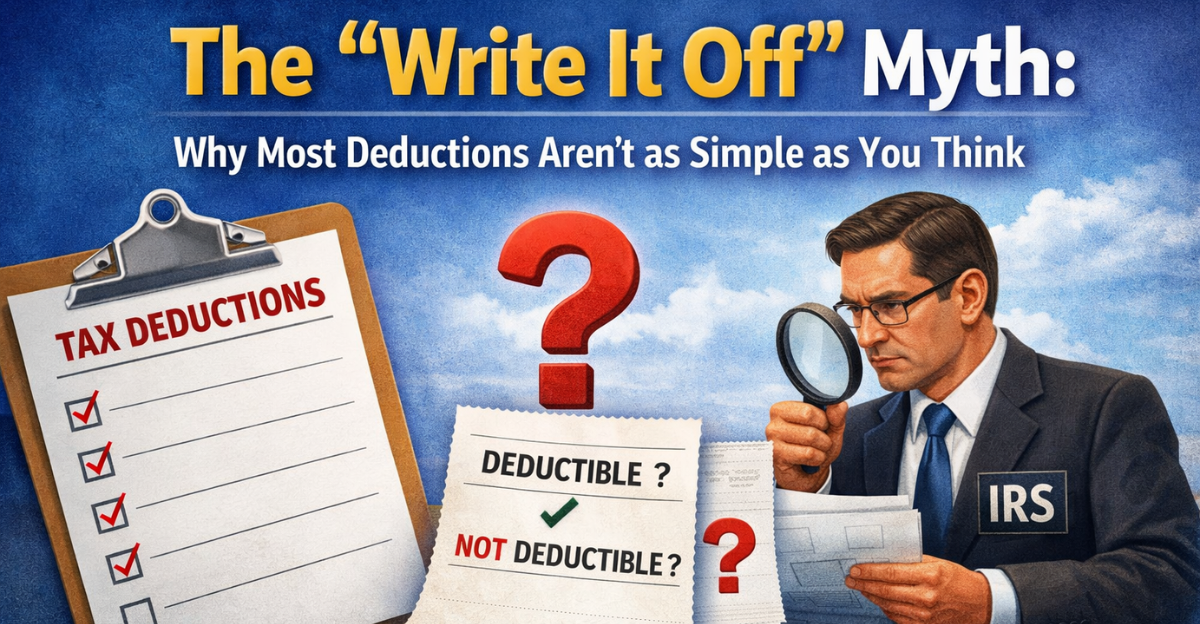
“Just Write It Off” Sounds Cool… Until It Isn’t
If you’ve spent any time online, you’ve probably heard this:
“Just write it off.”
It’s thrown around like it’s some sort of cheat code. New laptop? Write it off. Dinner? Write it off. Trip? Definitely write it off. It makes taxes almost sound too easy. Because it is.
The Problem With “Write It Off” Advice
Here’s what that advice skips:
The IRS does not care what you call an expense. They care what it is.
To qualify as a deduction, something has to be:
- Ordinary (common in your industry)
- Necessary (helpful and appropriate for your business)
Not:
“I talked about business for five minutes”
“I posted it on Instagram”
“I feel like it counts”
Why This Gets 1099 Workers in Trouble
When you’re self-employed, no one is double-checking you. So people start stretching things like:
- Personal purchases labeled as business tools
- Trips labeled as work travel
- Everyday expenses labeled as content
And at first… nothing happens. That’s what makes it dangerous. Because the issue isn’t what you can get away with. It’s what you can defend.
What Actually Holds Up
Real deductions usually look like this:
- Software you need to run your business
- Equipment used directly for your work
- Marketing and advertising costs
- Legitimate business travel
- Professional services (accountants, legal, etc.)
There’s a clear connection to making money. That connection is everything.
The Gray Area No One Explains
Here’s where it gets tricky.
A lot of expenses can be partially business… and partially personal.
Examples:
- Your phone
- Your car
- Your home
You can’t just write off 100% of those.
You have to: track usage, allocate correctly, keep records. That’s where most people mess up. Not because they’re trying to cheat. But because no one told them how detailed this is.
The Audit Risk No One Talks About
The IRS isn’t sitting there watching every transaction.
But patterns matter.
Things that raise eyebrows:
- High deductions compared to income
- Lots of “rounded” numbers
- Expenses that don’t match your type of business
- No documentation
And when something does get reviewed…
You don’t get to say, “I saw it on social media.”
The Smarter Way to Think About Deductions
Instead of asking:
“Can I write this off?”
Ask:
“Can I clearly explain why this exists for my business?”
If the answer is unsteady…
The deduction probably is too.
Where TaxHakr Comes In
This is exactly why most 1099 workers struggle.
Instead of guessing:
- It looks at your actual spending
- Identifies what’s truly deductible
- Helps you document it correctly
And you’re not doing it alone.
The Take Away
You don’t need to:
- Memorize tax law
- Guess your way through deductions
- Or try to “hack” the system
You do need:
- Clear tracking
- Real strategy
- A system that understands your situation
The Bottom Line
“Just write it off” is one of the most expensive pieces of advice online.
Not because deductions are bad.
But because misunderstanding them is.
The goal isn’t to write off everything.
It’s to write off the right things.
And do it in a way that actually holds up.
That’s the difference between:
Saving money…
and creating problems.
Disclaimer
This content is for informational purposes only and does not constitute tax, legal, or financial advice. Tax laws and enforcement practices change, and individual situations vary. Always consult a qualified tax professional for advice specific to your situation.
Leave a Reply