If you’re self-employed, freelance, or run a small business, your income probably isn’t neat and predictable. One year you’re cruising. The next year you’re on fire, or tightening your belt.
So when income changes in 2026, the big question becomes:
Do you base estimated tax payments on last year’s income… or what you’re making now?
The answer is both simpler and more flexible than most people realize.
Let’s break it down without tax jargon or panic spirals.
The Short (Honest) Answer
You can base your estimated tax payments on either:
Last year’s tax liability
or
This year’s expected income
As long as you follow a few safe rules, the Internal Revenue Service doesn’t care which method you use, they care that you pay enough and on time.
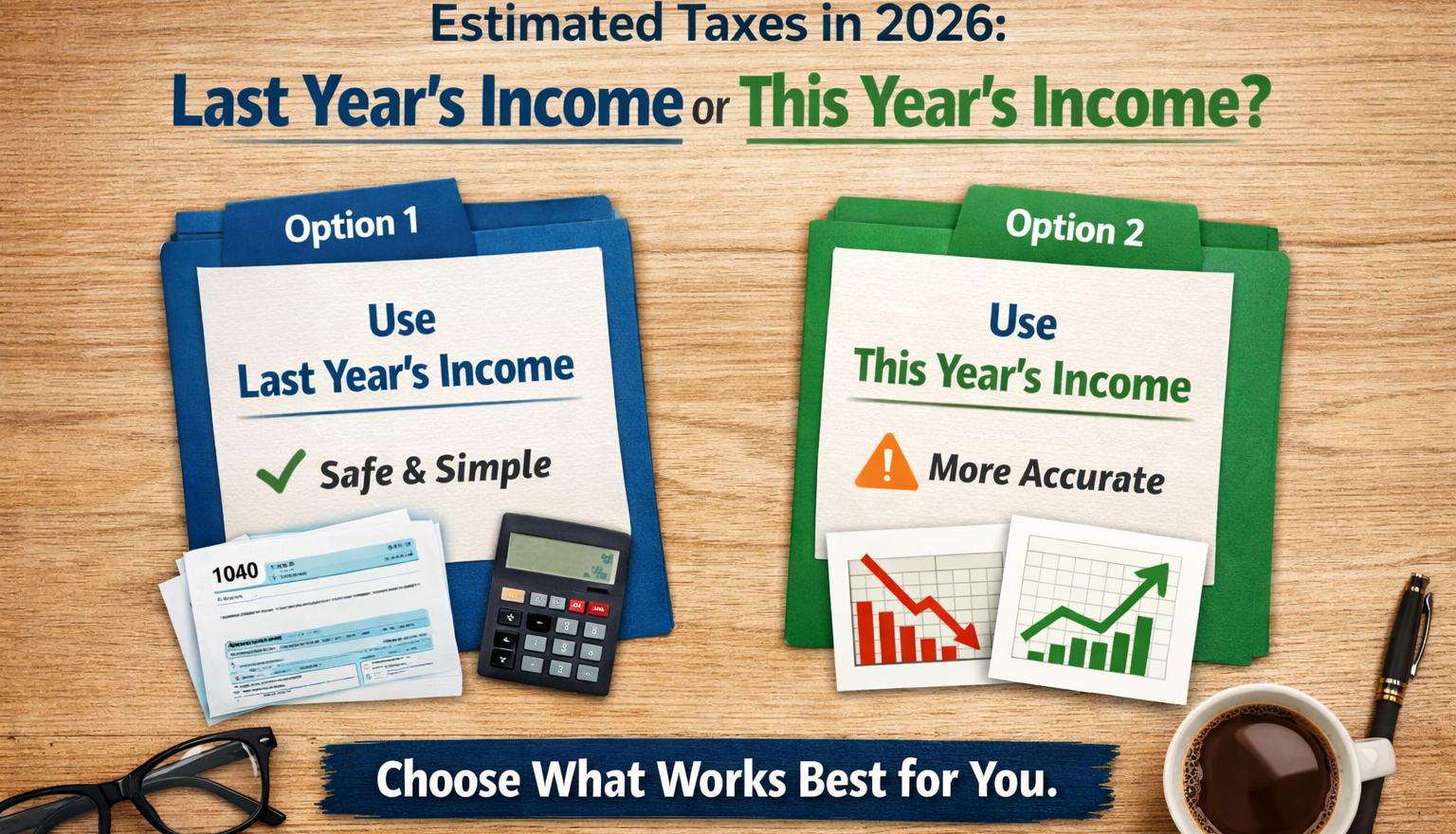
Option 1: Use Last Year’s Income (The “Safe Harbor” Rule)
This is the lowest-stress option.
The IRS has what’s called Safe Harbor rules, which protect you from underpayment penalties even if your income changes.
You’re generally safe if you pay:
- 100% of last year’s total tax, or
- 110% of last year’s tax if your income was higher (usually over $150,000)
✅ Even if you make more money in 2026
✅ Even if your income jumps mid-year
✅ Even if your estimates are technically “wrong”
As long as you meet safe harbor, penalties are off the table.
Why people like this method:
- Predictable
- Easy to calculate
- No constant recalculating
- Great for volatile income
Option 2: Base Payments on This Year’s Income (More Accurate, More Work)
If your income is significantly lower in 2026, or you want to avoid overpaying, you can base estimated payments on what you expect to earn this year.
This works well if:
- You lost a major client
- You scaled back work
- You had a one-time income spike last year
- Cash flow matters more than simplicity
⚠️ The risk?
If you underestimate and don’t pay enough by each quarterly deadline, penalties can apply.
This approach requires:
- Regular income tracking
- Updated projections
- Adjusting payments quarter by quarter
What If Income Changes Mid-Year?
This is where most people get tripped up.
Good news: Estimated taxes are not locked in.
You can:
- Pay more in later quarters if income increases
- Pay less if income drops
- Adjust payments as new information becomes available
The IRS looks at payments per quarter, not just total for the year.
So if Q1 and Q2 were slow but Q3 explodes? You can catch up.
Which Option Is Better in 2026?
Here’s the practical rule of thumb:
- Income unpredictable or growing?
👉 Use last year’s safe harbor - Income clearly lower this year?
👉 Use this year’s projected income - Don’t want surprises or penalties?
👉 Safe harbor + adjust later if needed
There’s no moral victory for guessing perfectly, just fewer headaches for paying smart.
Common Mistakes to Avoid
❌ Waiting until tax time to “see how it shakes out”
❌ Assuming one bad quarter means no estimates are needed
❌ Forgetting that self-employment tax still applies
❌ Paying nothing because income is inconsistent
Inconsistent income doesn’t mean inconsistent rules.
How TaxHakr Helps (Without Guessing)
This is exactly where most freelancers and 1099 workers struggle, because spreadsheets don’t think ahead.
TaxHakr:
- Tracks real-time income changes
- Adjusts projections as you earn
- Flags underpayment risk early
- Helps you choose safe vs optimized strategies before penalties happen
No panic payments. No surprise balances. No “hope for the best” tax planning.
Final Takeaway
If your income changes in 2026:
- You can use last year’s income safely
- You can adjust based on this year if you’re confident
- You should revisit estimates when income shifts
The goal isn’t perfection, it’s control.
And control beats guessing every time.
Disclaimer
This content is for informational purposes only and does not constitute tax, legal, or financial advice. Tax laws and enforcement practices change, and individual situations vary. Always consult a qualified tax professional for advice specific to your situation.
Leave a Reply