
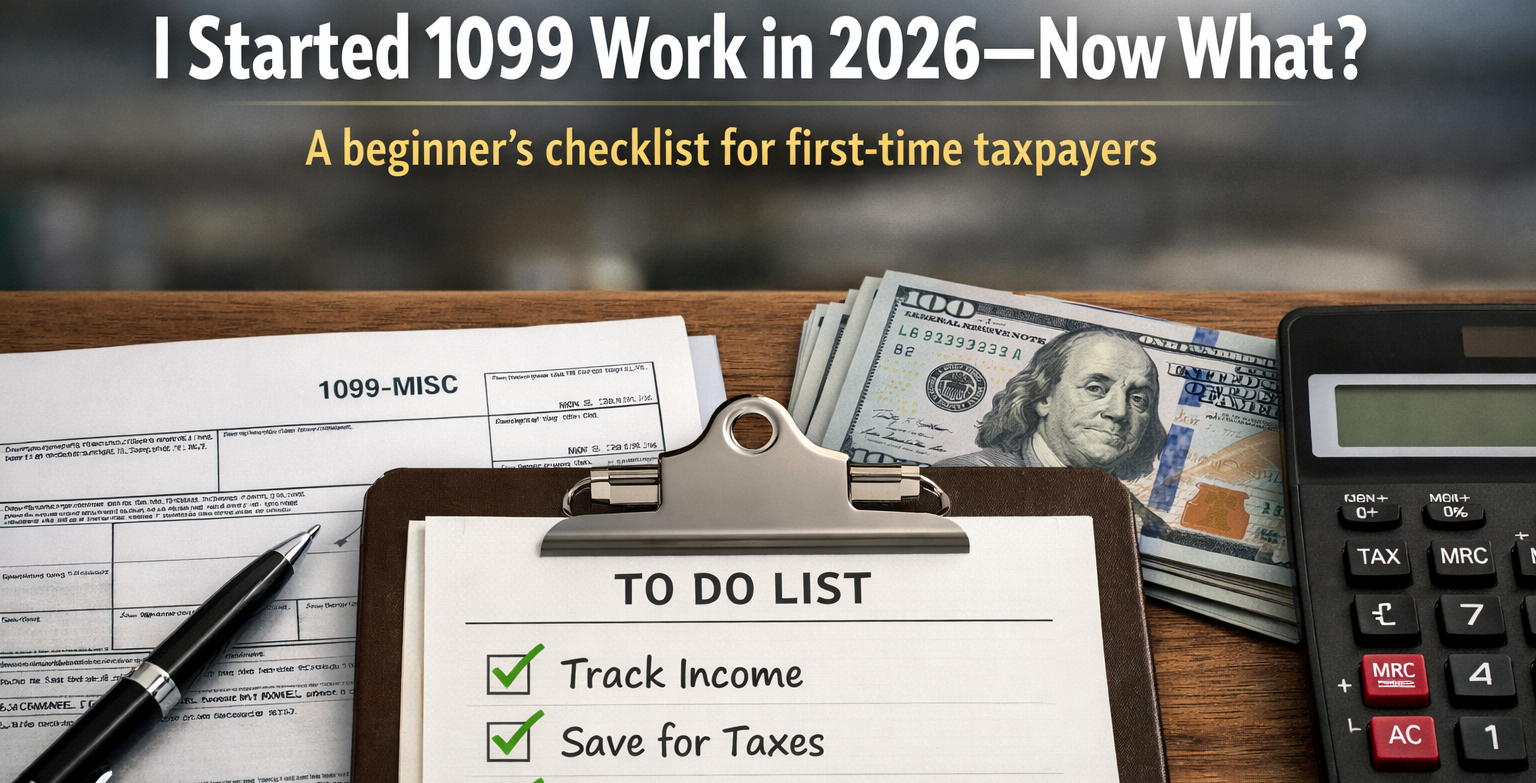
First of all… congrats.
Whether you picked up a side hustle, left your W-2 job, started freelancing, began driving for a gig app, or launched your own business – welcome to the world of 1099 income.
Now comes the question everyone asks:
“Okay… now what do I do about taxes?”
Take a breath. Here’s your beginner checklist. Simple, clear, and IRS-friendly.
Step 1: Understand What Changed
When you work a W-2 job:
- Taxes are automatically withheld
- Your employer pays half your Social Security & Medicare
When you work 1099:
- No taxes are withheld
- You pay both sides of Social Security & Medicare (called self-employment tax)
- You are considered self-employed
Basically – No one is pulling taxes out for you anymore.
Step 2: Separate Your Money (Immediately)
Before you earn another dollar:
✔ Open a separate business checking account
✔ Use a separate debit or credit card for business expenses
✔ Stop mixing personal and business spending
This one move alone prevents most tax headaches.
Step 3: Start Tracking Every Business Expense
If you don’t track it, you don’t deduct it.
Common beginner 1099 deductions include:
- Mileage
- Home office
- Phone & internet (business portion)
- Software subscriptions
- Equipment
- Supplies
- Advertising
- Education related to your business
- Bank & payment processing fees
Don’t guess. Track in real time.
Waiting until tax season = missed deductions.
Step 4: Set Aside Money for Taxes
Here’s the rule of thumb I give beginners:
👉 Set aside 25–30% of your net profit for taxes.
Not 25% of everything you make.
25% of what’s left after expenses.
Put it in a separate savings account labeled “Tax Money. Do Not Touch.”
Future you will be grateful.
Step 5: Learn About Quarterly Taxes
If you expect to owe $1,000 or more in federal taxes for the year, the IRS expects you to make estimated quarterly payments.
These are typically due:
- April
- June
- September
- January (of the following year)
You don’t wait until April 2027 to pay for 2026 income.
Quarterly payments help you:
- Avoid penalties
- Avoid giant tax bills
- Avoid stress
Step 6: Know What Forms You’ll File
As a 1099 worker, your tax return will usually include:
- Schedule C (reports income & expenses)
- Schedule SE (calculates self-employment tax)
- Form 1040
If a company paid you $600 or more, you’ll likely receive a 1099-NEC.
But here’s something important:
You must report all income, even if you don’t receive a 1099 form.
Step 7: Stop Believing These Beginner Myths
Let’s clear a few things up:
❌ “I’ll just write everything off.”
Nope. It must be ordinary and necessary for your business.
❌ “If I don’t get a 1099, I don’t report it.”
Wrong. All income is taxable.
❌ “My CPA will find all my deductions.”
They file what you provide. They don’t magically reconstruct your year.
❌ “I’ll fix it later.”
Later usually means more taxes.
Step 8: Build a Simple System
You don’t need something complicated.
You need:
- Real-time expense tracking
- Mileage tracking
- A tax estimate calculator
- Clean reporting for Schedule C
The earlier you build the system, the easier tax season becomes.
Step 9: Think Beyond Just “Filing”
The biggest mistake first-year freelancers make?
They think taxes are about filing.
Taxes are about strategy.
Once you understand deductions, retirement contributions, health insurance write-offs, and business structure planning, you stop reacting to taxes and start controlling them.
But first-year goal?
Stay organized. Stay compliant. Avoid penalties.
Beginner 1099 Checklist (Quick Recap)
✔ Separate bank account
✔ Track every expense
✔ Track mileage
✔ Set aside 25–30% for taxes
✔ Understand quarterly payments
✔ Keep records organized
✔ Report all income
✔ Don’t wait until tax season
Final Advice From a Tax Pro
Starting 1099 work in 2026 isn’t scary.
Ignoring it is.
If you build good habits in Year One:
- You avoid IRS stress
- You keep more of your money
- You grow smarter every year
Welcome to self-employment.
Now let’s make sure you don’t overpay Uncle Sam.
Disclaimer
This content is for informational purposes only and does not constitute tax, legal, or financial advice. Tax laws and enforcement practices change, and individual situations vary. Always consult a qualified tax professional for advice specific to your situation.
Leave a Reply