
Let’s clear something up right away:
The IRS does not require you to live in a shoebox full of crumpled receipts.
But they do require proof, especially if you ever need to prove business expenses to the IRS in an audit.
There are usually two extremes:
People who keep nothing.
And people who keep everything, including a receipt for a $2 coffee from 2018.
Neither approach is ideal.
So let’s break down what you actually need to prove business expenses to the IRS.
The IRS Has 4 Basic Rules for Business Expenses
For an expense to be deductible, it must be:
- Ordinary – Common and accepted in your industry
- Necessary – Helpful and appropriate for your business
- Reasonable – Not wildly excessive
- Documented – This is the part everyone forgets
The first three are judgment calls.
The fourth is where audits are won or lost.
Want more information about business expenses? Check out other blog posts in the Rebel Ledger
Did You Know You Can Deduct Bank Fees and Credit Card Processing Fees?
Can You Deduct Clothes? The Truth About Work Boots vs. “Nice Jeans”
Can You Deduct Professional Development (Courses, Books, Even Podcasts)?
Claiming 100% Business Use on Your Car: Why It Screams “Audit Me”
Interested in learning more detailed information about other kinds of expenses? Let us know in the comments!
What the IRS Actually Wants to See
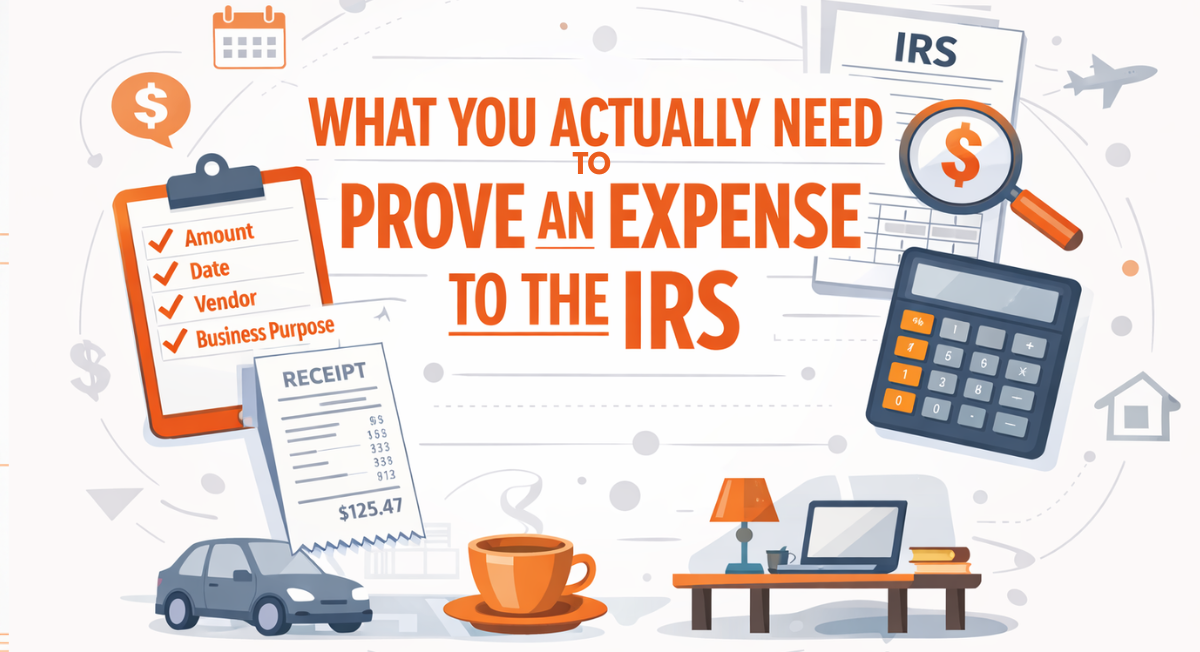
At minimum, you need documentation that shows:
- Amount (How much was spent?)
- Date (When did it happen?)
- Place/Vendor (Where was it spent?)
- Business purpose (Why was it for business?)
That’s it.
If you can clearly answer those four questions, you’re 90% of the way there.
Did you know that TaxHakr can help with that?
Do You Really Need Receipts for Everything?
Here’s the honest answer:
Yes, ideally. But not always technically.
Receipts Are Best Because They Show:
- Vendor name
- Exact amount
- Date
- Itemized breakdown
A bank statement alone usually isn’t enough because it doesn’t show what was purchased.
“Amazon – $143.82” tells the IRS nothing.
Was it printer ink? Office furniture? A waffle maker?
They don’t know. And in an audit, guessing doesn’t work.
Special Documentation Rules (Where People Mess Up)
Some categories have stricter rules.
🚗 Mileage
You need:
- Date of trip
- Starting location
- Destination
- Business purpose
- Miles driven
Reconstructing mileage at year-end is risky. The IRS prefers contemporaneous logs (tracked as you go).
🍽️ Meals
You need:
- Receipt
- Who you met with
- Business purpose
Writing “lunch” on a receipt isn’t enough.
🏠 Home Office
You need:
- Square footage of office
- Total home square footage
- Utility and expense records
No, taking a deduction because “I sometimes work on the couch” does not qualify.
What If You Lose a Receipt?
It happens.
If you lose one:
- Try to get a duplicate from the vendor
- Use credit card backup
- Add written documentation explaining the expense
If it’s a small amount, it may not raise red flags. If it’s thousands of dollars with no support? That’s a problem.
The $75 Rule (And Why People Misunderstand It)
You may have heard:
“You don’t need receipts under $75.”
Not exactly.
The IRS allows some exceptions for small expenses, but you still need proof of:
- Amount
- Date
- Business purpose
It’s not a free pass to ignore documentation.
What About Digital Records?
Good news: The IRS accepts digital copies.
You do NOT need paper.
Screenshots, scanned receipts, cloud storage, all acceptable.
What they care about is accuracy and clarity.
The Real Risk Isn’t the IRS — It’s You
Here’s what actually costs people money:
- Waiting until tax season to “figure it out”
- Using bank statements as your only record
- Mixing personal and business accounts
- Assuming their CPA will “find” deductions
CPAs aren’t detectives. They can file what you provide.
If it wasn’t tracked, it can’t be deducted.
How to Make This Easy
You need three things:
- Separate business account
- Real-time expense tracking
- Consistent categorization
That’s exactly why tools like TaxHakr exist.
Instead of guessing in March, you track in real time. Instead of rebuilding mileage, it’s logged in our system instead of hoping you have proof, it’s stored securely and organized.
Audit protection isn’t about being perfect, it’s about being consistent.
Bottom Line: Can You Defend It?
When it comes to IRS expense documentation, ask yourself one simple question: “If someone asked me to prove this next year, could I?”
If the answer is yes, you’re good.
If the answer is “I think so?”, fix your system.
Because deductions don’t matter if you can’t defend them.
If you’re a 1099 worker, freelancer, or small business owner who wants your deductions to actually stick, stop relying on memory.
Build a system. Or better yet — let one run for you.
That’s how you turn tax season from panic into strategy.
Disclaimer
This content is for informational purposes only and does not constitute tax, legal, or financial advice. Tax laws and enforcement practices change, and individual situations vary. Always consult a qualified tax professional for advice specific to your situation.
Leave a Reply